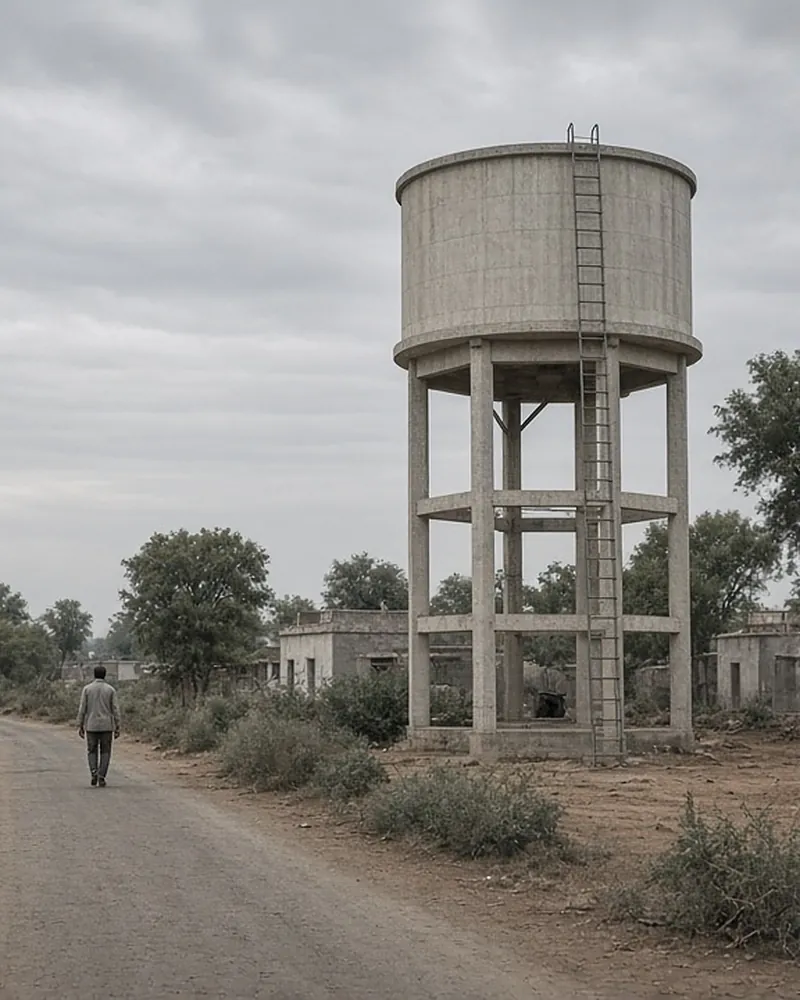
Jal Jeevan Mission was first meant to finish in 2024. It has now been extended to December 2028 and restructured as Jal Jeevan Mission 2.0 (JJM 2.0). The change is about more than time and money. The mission is moving from building infrastructure to delivering a reliable water service, with Gram Panchayats and village committees at the centre and a new digital system that maps every village scheme from source to tap.
The decision in short
There were two steps.
1 February 2025: the Budget announcement. Presenting the Union Budget 2025–26, the Finance Minister said the mission stood extended until 2028, with a focus on the quality of infrastructure and on the operation and maintenance of rural piped water schemes through Jan Bhagidari (people’s participation). She said separate MoUs would be signed with States and UTs to ensure sustainability and citizen-centric water service delivery. The budget estimate for the mission in 2025–26 was ₹67,000 crore. (PIB, 1 Feb 2025)
10 March 2026: the Cabinet approval. The Union Cabinet approved the Ministry of Jal Shakti’s proposal to restructure the mission and extend it up to December 2028, with an enhanced outlay. (PIB, 10 Mar 2026)
The Operational Guidelines for JJM 2.0 were then issued by the National Jal Jeevan Mission in 2026 and are available in the official guidelines library.
Old and new outlay compared
Two kinds of number appear in the news, and they are often mixed up. The total outlay is the whole mission’s cost over its life, shared by the Centre and the States. The annual budget is what the Centre sets aside for one financial year.
| Item | Original (2019) | JJM 2.0 (2026) |
|---|---|---|
| Period | 2019–20 to 2023–24 | Up to Dec 2028 |
| Total outlay | ₹3.60 lakh crore | ₹8.69 lakh crore |
| Central share | ₹2.08 lakh crore | ₹3.59 lakh crore |
| Extra central share | – | ₹1.51 lakh crore |
Sources: PIB 2114280; PIB 2237548.
| Year | Union budget estimate for JJM |
|---|---|
| 2025–26 | ₹67,000 crore |
| 2026–27 | ₹67,670 crore |
Sources: PIB 2098368; PIB 2237015.
So when you read “₹67,670 crore”, that is one year’s central budget. “₹8.69 lakh crore” is the total cost of the mission, including the States’ share.
Why the mission was extended
When the mission began in 2019, about 3.23 crore rural homes (around 17%) had tap water. By the time of the Cabinet decision in March 2026, more than 12.56 crore more homes had been connected, and about 15.80 crore of 19.36 crore rural homes (81.61%) were reported to have taps. On 12 November 2026 the official dashboard showed 82.63%.
That still left more than 3 crore homes without a tap, concentrated in a few large States. You can see which on State-wise coverage.
There was also a quality problem. The official Functionality Assessment of 2024 found that only 76% of household tap connections met all three tests of quantity, quality and regularity together. JJM 2.0 is designed to fix both problems: finish the remaining homes, and keep the existing taps working.
From building pipes to delivering a service
The biggest shift in JJM 2.0 is in thinking. The first phase was measured largely by connections fitted. The second phase is measured by water delivered.
The JJM 2.0 guidelines set out:
- A clear chain of responsibility from the national level to the Gram Panchayat. The Gram Panchayat, through its standing committee for water and sanitation, is placed at the core of service delivery, and the VWSC acts as its executive arm for day-to-day work.
- District Technical Units to give Gram Panchayats engineering support and guide operation and maintenance.
- A utility approach, with village-level “micro utilities” and larger State or regional “macro utilities” for bulk water schemes.
- Support from Self-Help Groups and Primary Agricultural Credit Societies for jobs like collecting water charges and testing water.
- Comprehensive Implementation and Reform Plans from each State, setting out how remaining schemes will be finished and handed over.
- Long-term goal of assured 24×7 rural drinking water, in line with Viksit Bharat @2047.
Sujalam Bharat and the Sujal Gaon ID
Under JJM 2.0 a national digital framework called Sujalam Bharat is being set up. Every village, or more precisely every service area or habitation, gets a unique Sujal Gaon ID. Each ID links to a digital map of the whole water supply system for that area, from the source and treatment plant to the pipes and household taps.
The purpose is to give officials and citizens one consistent record of what exists, where it is, and whether it is working. The guidelines also describe interactive dashboards at national, State, district and Panchayat levels, and integration with the Meri Panchayat mobile app for citizen feedback and grievances.
Jal Arpan: handing the scheme to the village
Jal Arpan is the formal handover of a finished water supply scheme to the Gram Panchayat and VWSC. Under the guidelines, a scheme is handed over only after a trial run of at least 15 days and verification that it performs as designed, including delivering 55 litres per person per day at the tail end of the network. The handover ceremony, called Jal Arpan Diwas, takes place in the presence of the community, and assets, documents and responsibilities are transferred to the village.
After handover, the Gram Panchayat and VWSC are responsible for day-to-day operation and maintenance, while the district and the State water department provide oversight, technical guidance and help with major repairs.
Har Ghar Jal declaration under JJM 2.0
A village is declared “Har Ghar Jal” when every home has a tap. Under JJM 2.0 the Cabinet added a condition: a Gram Panchayat shall certify completion and declare itself Har Ghar Jal only after confirming that the State has set up adequate in-village operation and maintenance arrangements. In other words, certification is meant to show that water will keep flowing, not just that pipes were laid. The JJM 2.0 target is to certify every Gram Panchayat as Har Ghar Jal by December 2028. See Har Ghar Jal certification.
Jal Utsav
Jal Utsav is an annual, community-led event for maintaining and checking the village water system. The Cabinet described it as a way to build collective responsibility and community ownership, drawing on local culture. The Gram Panchayat and VWSC jointly promote it. Alongside it, the Gram Panchayat holds an annual functionality check called Jal Seva Aankalan, and the results are presented village by village in the Gram Sabha.
State MoUs and reform plans
Both the 2025 Budget speech and the 2026 Cabinet decision said that separate MoUs would be signed with each State and UT. The Cabinet briefing said these should be signed within three months. The MoUs tie central funding to structural reforms, such as handing schemes to Gram Panchayats, setting up operation and maintenance arrangements, and meeting timelines.
How funds are shared between Centre and States
The Centre:State funding pattern continues under JJM 2.0:
| Component | UTs without legislature | NE & Himalayan States, UTs with legislature | Other States |
|---|---|---|---|
| Tap coverage works | 100:0 | 90:10 | 50:50 |
| Support and water quality | 100:0 | 90:10 | 60:40 |
Source: Operational Guidelines JJM 2.0, funding pattern table.
On top of this, the community contributes towards in-village works: 5% of the capital cost in hilly and forested areas, North Eastern and Himalayan States and villages where more than half the population is SC/ST, and 10% elsewhere. If a State decides not to collect this, the State pays that share from its own funds. After commissioning, a village can be rewarded in phases with up to 10% of the in-village capital cost, kept as a revolving fund for repairs. Use the checker on Pani Samiti (VWSC) to see which rate applies.
Progress at a glance: 2019 to 2026
| Date | Rural homes with tap water | Share |
|---|---|---|
| 15 Aug 2019 | 3.23 crore | about 17% |
| March 2024 | more than 11.39 crore added | around 75% |
| 3 Mar 2026 | 15.82 crore | 81.71% |
| 12 Nov 2026 | 15,99,23,816 | 82.63% |
Sources: Operational Guidelines JJM 2.0; PIB, 9 Mar 2026; JJM Dashboard.
The pace has slowed as coverage has risen, because the last homes are often the hardest: remote hamlets, desert districts and areas where groundwater is contaminated and water has to be piped in from far away. JJM 2.0 pairs the deadline with reforms meant to keep finished schemes working, so that a household connected in 2021 is still getting water in 2028.
Who does what under JJM 2.0
| Level | Main role |
|---|---|
| Centre (NJJM) | Funds, policy, Sujalam Bharat, monitoring |
| State (SWSM, water department) | Builds schemes, signs MoU, runs bulk supply |
| District (DWSM, DTU) | Approves village schemes, technical support |
| Gram Panchayat / VWSC | Runs the village system, charges, complaints |
Source: Operational Guidelines JJM 2.0.
What this means for a household
- If your home has no tap yet: the mission now has money and a deadline, December 2028, to reach you. Ask your Pani Samiti or Gram Panchayat whether your home is in the village plan. See How to get a tap connection.
- If you have a tap but little or no water: JJM 2.0 is built around service, not just connections. The village committee, the district technical unit and the State water department are all expected to act on complaints. See Complaints.
- If you want to see what is happening: the JJM Dashboard and its Citizen Corner publish coverage and water quality data for every village.
FAQ
Has Jal Jeevan Mission been extended to 2028?
Yes. It was announced in the Budget on 1 February 2025 and approved by the Cabinet on 10 March 2026, extending the mission up to December 2028.
What is the new outlay for Jal Jeevan Mission?
The total outlay is ₹8.69 lakh crore, with central assistance of ₹3.59 lakh crore, up from ₹2.08 lakh crore approved in 2019–20.
What is the Jal Jeevan Mission budget for 2026–27?
The budget estimate for 2026–27 is ₹67,670 crore. That is a single year’s central allocation, not the total outlay.
What is Jal Jeevan Mission 2.0?
It is the restructured phase of the mission up to December 2028, which shifts the focus from building infrastructure to reliable service delivery, with Gram Panchayat ownership, Sujalam Bharat digital mapping, Jal Arpan handover and annual Jal Utsav.
What is Sujalam Bharat?
It is the national digital framework under JJM 2.0 that gives every village or service area a unique Sujal Gaon ID and maps its water system from source to tap.
What is Jal Arpan?
Jal Arpan is the formal handover of a completed water scheme to the Gram Panchayat and VWSC, after a trial run of at least 15 days and verification.