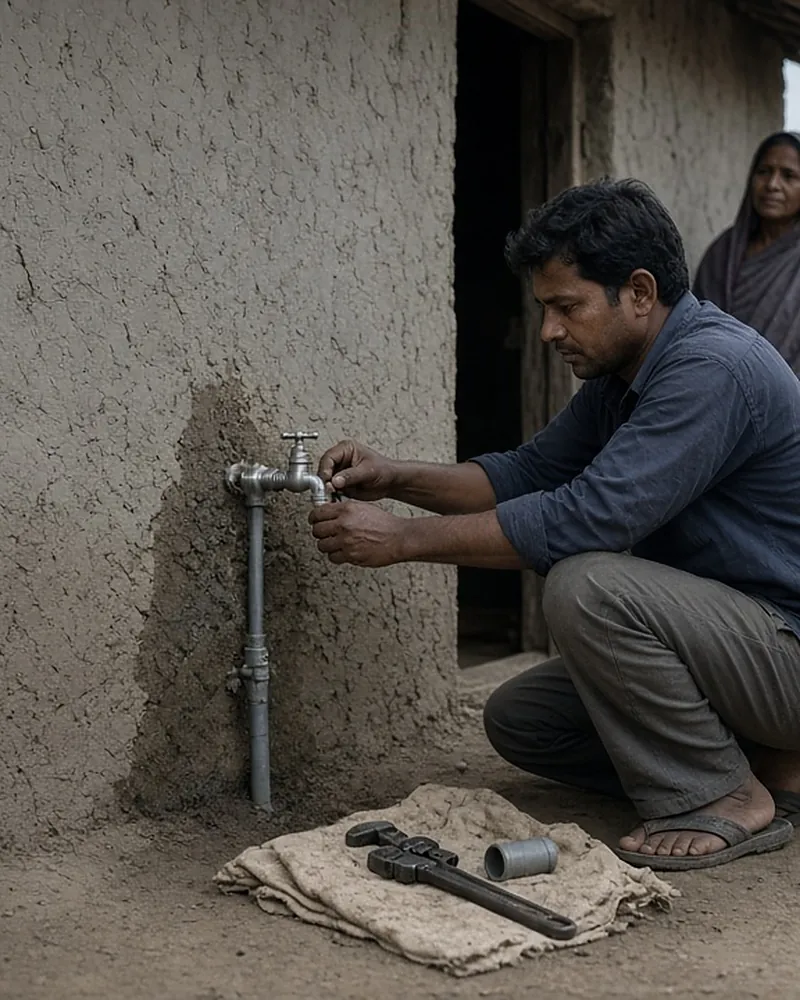
Many people search for “Jal Jeevan Mission apply online” or a “Har Ghar Jal registration form”. The honest answer is that there is no national online application for an individual tap connection. Jal Jeevan Mission does not work home by home through forms. It works village by village: the Gram Panchayat and its village water committee plan a scheme for the whole village, and every household in that plan gets a tap.
That is good news in one way. You do not need to fill in a form, pay an agent or wait in a queue. But it does mean you need to make sure your home is included in your village’s plan, and know whom to ask if it is not. Here is the route, step by step.
The short answer
| Question | Answer |
|---|---|
| Is there a national online form? | No |
| Who decides which homes get taps? | Gram Panchayat / Pani Samiti, approved by the Gram Sabha |
| Who builds the scheme? | The State water department or its agency |
| Is there a fee to apply? | No application fee; the village shares part of the cost |
| Where can I see progress? | JJM Dashboard |
Some States run their own portals or apps for scheme information and complaints. Those are run by the State government, and the right one for your area is on your State water or Public Health Engineering department’s official website.
Who can get a tap
Every rural household is meant to get a Functional Household Tap Connection under Jal Jeevan Mission. There is no income limit, caste condition or card you must hold. The mission also covers schools, anganwadi centres, Gram Panchayat buildings, health and wellness centres and community buildings in the village.
The mission’s objectives give priority to villages with water quality problems, drought-prone and desert areas, and Sansad Adarsh Gram Yojana villages. The Cabinet’s target under JJM 2.0 is to reach all 19.36 crore rural households by December 2028. (PIB, 10 March 2026)
Step-by-step route
| Step | What to do | Who to contact |
|---|---|---|
| 1 | Find out if your village has a sanctioned scheme | Gram Panchayat / Pani Samiti |
| 2 | Check your home is in the Village Action Plan | Pani Samiti |
| 3 | Attend the Gram Sabha that approves the plan | Gram Sabha |
| 4 | Agree the household’s part of the community share | Pani Samiti |
| 5 | Allow the tap to be fitted and verified | Department / contractor |
| 6 | Start paying the monthly water charge | Pani Samiti |
1. Ask whether your village has a scheme. Visit the Gram Panchayat office or speak to a Pani Samiti member. You can also look up your village on the JJM Dashboard or the Citizen Corner to see whether it shows tap connections or Har Ghar Jal status.
2. Make sure your home is in the Village Action Plan. The Village Action Plan lists every household, school and anganwadi to be connected. It is prepared by the Gram Panchayat or Pani Samiti and approved by the Gram Sabha. Homes at the edge of a village, in a separate hamlet, or built recently are the ones most often missed.
3. Go to the Gram Sabha. The Gram Sabha approves the plan and the community’s willingness to contribute. The official guidelines treat the community’s willingness, shown through a Gram Sabha resolution and contribution, as the foremost criterion for taking up a scheme. This is the best moment to point out a missing home.
4. Agree your share of the community contribution. The village contributes 5% or 10% of the capital cost of in-village works, in cash, kind or labour. The Pani Samiti decides how it is collected. Poor, infirm or divyang people and widows without steady income can be exempted, and instalments are allowed. If your State has decided not to collect the contribution, the State pays it instead. See Pani Samiti (VWSC) for the rate checker.
5. Let the connection be fitted and verified. The State’s water department or its contractor lays the pipes and fits the tap. To record the connection on the mission’s system, the department verifies the name and Aadhaar number of the head of household. This is done by the department in the village as part of the official process. Keep any receipt or slip you are given.
6. Pay the water charge. Once the scheme is tested and handed over to the village through Jal Arpan, the Pani Samiti runs it and collects a service charge to pay for electricity, disinfection, repairs and the operator. Ask what the charge is and what it covers.
If your home was left out of the village plan
It happens, especially with new houses or scattered hamlets. What to do:
- Write to the Pani Samiti and Gram Panchayat giving your name, ward or hamlet, and the problem: “home not included in the Jal Jeevan Mission scheme”. Keep a copy with the date.
- Raise it at the Gram Sabha, particularly during the annual Jal Seva Aankalan or Jal Utsav.
- Contact the block or district office of your State’s rural water or Public Health Engineering department. The District Water and Sanitation Mission, headed by the District Collector, approves in-village schemes.
- Use CPGRAMS at pgportal.gov.in if it is still not resolved. Complaints received by the Centre are forwarded to the State water department.
The full complaint route is on Jal Jeevan Mission complaint.
Community contribution and exemptions at a glance
| Rule | Official position |
|---|---|
| Rate | 5% (hilly/forested, NE or Himalayan State, >50% SC/ST) or 10% |
| Form | Cash, kind or labour |
| Exemptions | Poor, infirm, divyang, widows without steady income (GP decides) |
| Instalments | Allowed |
| State waiver | State pays the share from its own funds |
Sources: JJM Operational Guidelines (2019), para 6.1.2; Operational Guidelines JJM 2.0, para 3.3.11.
Water charges after the connection
Jal Jeevan Mission aims for water at “affordable service delivery charges”. The money pays for running the system, not for profit. The Gram Panchayat or VWSC keeps a separate account for operation and maintenance, which also receives mission incentive funds and Finance Commission grants. Under JJM 2.0 these accounts are to be audited every year, and the results of the annual Jal Seva Aankalan are presented in the Gram Sabha. If you are asked to pay, ask for a receipt.
How long it takes
There is no fixed waiting time for a household, because connections follow the village scheme. The scheme has to be planned, approved, built, tested and handed over. Under JJM 2.0 a finished scheme is handed to the village only after a trial run of at least 15 days. The national target is to reach every rural home by December 2028. Your Pani Samiti or the State water department can tell you where your village’s scheme stands, and the JJM Dashboard shows village progress.
Tips for a smooth connection
- Ask where the tap will be placed before work starts, so it is convenient and does not block a doorway or drain.
- Check that the connection pipe is buried or protected where it crosses a lane.
- Note the name of the Nal Jal Mitra or Pani Samiti member to call if it leaks.
- Make sure any receipt for your contribution or charge carries the Pani Samiti or Gram Panchayat’s name.
Documents and personal details
There is no national list of documents for a household tap, because there is no individual application. The department records the head of household’s name and Aadhaar number when it verifies a connection, as part of the official process carried out in the village.
To stay safe:
- Share identity details only with Gram Panchayat, Pani Samiti or State water department staff during official work, never with a website, caller or messaging-app contact who says they can “register” you.
- Never share an OTP or bank PIN for a water connection.
- Pay community contribution or water charges only to the Pani Samiti or Gram Panchayat, and get a receipt.
Fake “registration lists”, forms and job offers
Search results and messages sometimes promise things that the mission does not offer:
| Claim you may see | The fact |
|---|---|
| “Apply online for Har Ghar Jal” | No national online form exists for a household tap |
| “Check your name in the registration list PDF” | Homes are listed in the Village Action Plan held by the Gram Panchayat |
| “Pay to get your tap faster” | Connections follow the village plan; there is no fast-track fee |
| “Download your Har Ghar Jal certificate” | Certification is a village-level Gram Sabha resolution |
| “JJM login for citizens” | Dashboard and WQMIS logins are for officials and labs |
| “Jal Jeevan Mission bharti / recruitment” | Check any job only on official State or Central government sites |
Urban homes: a different mission
Jal Jeevan Mission is for rural households. Homes in towns and cities are covered by the urban water supply mission of the Ministry of Housing and Urban Affairs, through the local municipal body. See AMRUT and the related schemes page. To see how far the rural mission has reached in your State, use State-wise coverage.
FAQ
How can I apply online for a Jal Jeevan Mission tap connection?
There is no national online application. Ask your Gram Panchayat or Pani Samiti to include your home in the Village Action Plan.
Is there a registration fee for Har Ghar Jal?
No. There is no application or registration fee. The village contributes 5% or 10% of the cost of in-village works, and households pay a monthly water charge once the scheme runs.
What documents do I need for a tap connection?
There is no national document list because there is no individual application. When the department verifies a connection, it records the head of household’s name and Aadhaar number in the village.
My house was missed in the survey. What should I do?
Write to the Pani Samiti and Gram Panchayat, raise it at the Gram Sabha, and if needed contact the block or district water department or file a grievance on CPGRAMS.
Who pays for the tap and pipes?
The Centre and the State share the cost of the scheme, and the village contributes 5% or 10% of the in-village capital cost. Households pay a service charge for running the system.
Can urban homes get a tap under Jal Jeevan Mission?
No. Jal Jeevan Mission covers rural homes. Urban water supply is handled by municipal bodies under the Ministry of Housing and Urban Affairs.