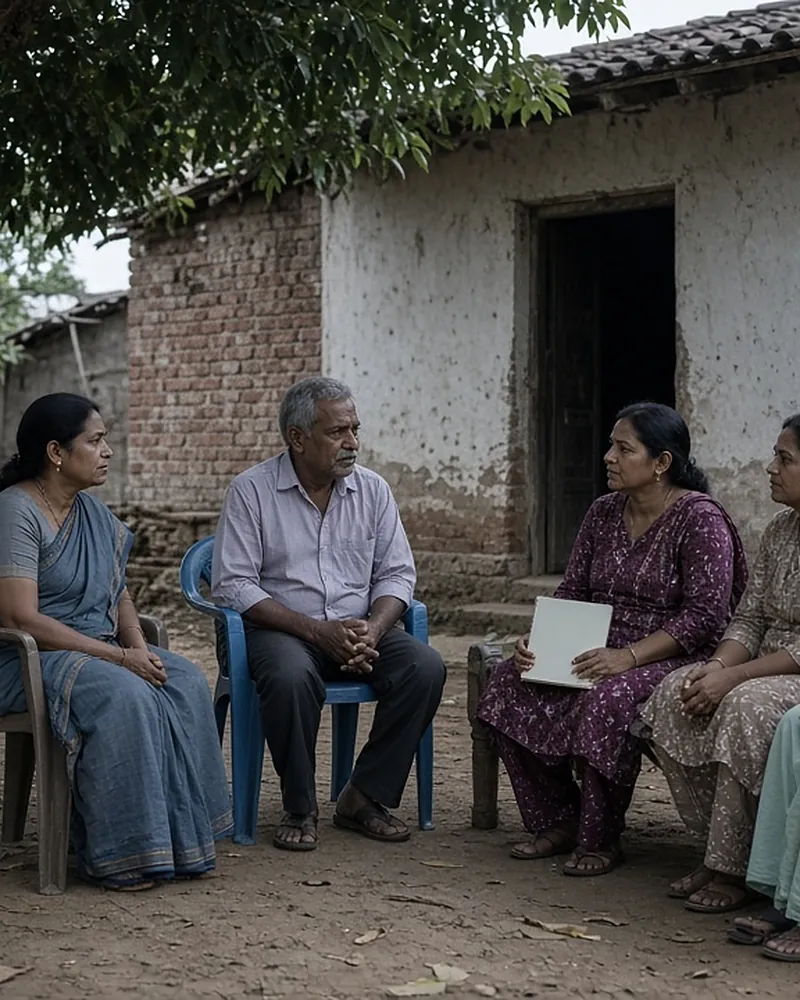
Jal Jeevan Mission is built on one idea: the village should own its water system. The body that makes that happen is the Village Water and Sanitation Committee (VWSC), also called the Pani Samiti or a user group. It is a committee of the Gram Panchayat that plans the village water scheme, collects the community’s share of the cost, watches over construction, and then runs and maintains the system for years afterwards.
If you want a tap for your home, want to know when water will come, or need something fixed, the Pani Samiti is usually the first place to go.
What a VWSC or Pani Samiti is
Under the mission, the Gram Panchayat and/or its sub-committee functions as a legal entity in line with the 73rd Amendment to the Constitution, which created the Panchayati Raj system. The Gram Sabha decides whether the Gram Panchayat itself will manage water supply, or whether a sub-committee (VWSC, Pani Samiti or user group) will do it. The State government issues a notification under its Panchayati Raj Act to give the committee its legal footing.
Under JJM 2.0, the Gram Panchayat, through its standing committee for water and sanitation, sits at the core of service delivery, and the VWSC acts as its executive arm, handling day-to-day work.
Source: Institutional mechanism; Operational Guidelines JJM 2.0.
Who sits on it
| Seat | Share or role |
|---|---|
| Total members | 10 to 15 |
| Elected Panchayat members | Up to 25% |
| Women | 50% |
| Weaker sections (SC/ST) | Remaining 25%, in proportion to population |
| Chairperson | Sarpanch, Up-Sarpanch, a GP member or traditional head, as the Gram Sabha decides |
| Secretary | Panchayat Secretary, Patwari or Talati may act |
Source: Institutional mechanism.
The official guidance calls 50% women members “key to success”. Women and girls have carried the burden of fetching water, and they are often the first to know when supply fails or water tastes wrong.
Tenure and how it is formed
- The Gram Sabha forms the committee and can reconstitute it during the mission period.
- The tenure is ordinarily 2 to 3 years.
- If the term of elected Panchayat members on the committee ends, the District Water and Sanitation Mission ensures the committee continues until the Gram Panchayat is reconstituted.
- Where there is no elected Gram Panchayat, the committee can be headed by traditional or senior village leaders, as the village council decides.
Duties at each stage
| Stage | Main duties |
|---|---|
| Planning | Survey every home; prepare the Village Action Plan; get Gram Sabha approval; mobilise the community share |
| Building | Supervise in-village works; check quality; keep records; resolve local issues |
| Handover | Take charge of the scheme through Jal Arpan after the trial run |
| Running | Daily operation, minor repairs, chlorination, water testing, water charges, accounts and complaints |
Sources: JJM Operational Guidelines (2019); Operational Guidelines JJM 2.0.
Under JJM 2.0, the Gram Panchayat and VWSC are responsible for day-to-day operation and maintenance, including upkeep of infrastructure, financial management, water quality monitoring, record keeping and grievance redressal. The district, its District Technical Unit and the State water department provide oversight, technical advice, training and support for major repairs.
The Village Action Plan
The Village Action Plan (VAP) is the village’s own plan for its water supply. It is prepared by the Gram Panchayat or Pani Samiti, with technical help from the State department and support agencies, and approved by the Gram Sabha. It sets out:
- every household, school and anganwadi to be connected;
- the water source and how it will be protected and recharged;
- the in-village works needed, such as storage tanks and pipelines;
- greywater management;
- the community contribution and how it will be collected;
- how the system will be run and paid for after handover.
The willingness of the community, shown by a Gram Sabha resolution and community contribution, is the foremost criterion for taking up a water scheme in a village. The 2019 guidelines set a pre-requisite of willingness and contribution from at least 80% of households.
If your home is missing from the plan, the time to say so is while the plan is being prepared, or at the Gram Sabha that approves it. See How to get a tap connection.
Community contribution: 5% or 10%
To build a sense of ownership, the community pays a share of the capital cost of in-village works, in cash, kind or labour. This is a village-level contribution towards the scheme, not a fixed bill per tap.
| Village type | Share of capital cost |
|---|---|
| Hilly or forested area | 5% |
| North Eastern or Himalayan State | 5% |
| More than 50% SC/ST population | 5% |
| All other villages | 10% |
Source: Operational Guidelines JJM 2.0, para 3.3.11.
Contribution rate checker. Answer three yes/no questions about your village: is it in a hilly or forested area, is it in a North Eastern or Himalayan State, and is more than half its population SC and/or ST? If any answer is yes, the rate is 5%. If all are no, it is 10%. The checker explains which condition applied, and it never asks for names, ID numbers or money.
5% or 10%? Village share checker
Answer the three questions to see the share.
A few more official rules:
- State exemption. If a State or UT decides not to collect the community contribution, the State must pay that amount from its own funds.
- Individual exemptions. The Gram Panchayat or committee may exempt individual contributions from poor, infirm or divyang people, or widows with no steady income. This is meant to be an exception, not the rule.
- Instalments. Households may be allowed to pay their part in instalments.
- What counts. Contributions by local Self-Help Groups count as community contribution. Donations from local institutions and philanthropists count towards the scheme cost but not as community contribution. MPLAD funds count as central share, and MLALAD and District Mineral Foundation funds count as State share.
- Reward. After commissioning, the community can be rewarded in phases with up to 10% of the capital cost of the in-village scheme. This is kept as a revolving fund for emergency repairs. It does not apply where the community contribution was not received.
Water charges and the O&M account
Once a scheme is handed over, someone has to pay for electricity, chemicals for disinfection, repairs and the pump operator. The Gram Panchayat or VWSC opens a bank account to receive funds for operation and maintenance from several sources:
- the community’s water charges (service delivery charges);
- incentive funds from the mission;
- Finance Commission grants to the Panchayat.
The guidelines describe recovery of user charges and full operation and maintenance cost recovery as the cornerstone of long-term sustainability. The charge itself is decided locally, so ask your Pani Samiti what it is and what it covers. Accounts of the Gram Panchayat or VWSC for community contribution and incentive money are to be audited every financial year under JJM 2.0.
Nal Jal Mitra and local technicians
A water system needs someone who can open valves, fix leaks and look after pumps. Under JJM 2.0, the VWSC may engage a Nal Jal Mitra, preferably local youth or ex-servicemen trained under the Nal Jal Mitra Programme, to:
- operate the piped water system, storage tanks, pumps, pipelines and disinfection units;
- carry out preventive maintenance and minor repairs;
- support village water quality monitoring alongside the trained women who use Field Test Kits;
- help the VWSC handle complaints;
- report problems to the District Technical Unit and the mission’s digital platforms.
The VWSC can also outsource work such as water testing, collecting water charges and functionality checks to Self-Help Groups, especially those linked to the State Rural Livelihood Mission, or to Primary Agricultural Credit Societies.
Water testing by trained women
Every village is meant to have five people, preferably women, trained to test water with Field Test Kits. Official guidance suggests drawing them from the ASHA or health worker, a Gram Panchayat or VWSC member, an SHG member, and the anganwadi teacher or helper. They test water, carry out sanitary inspections and upload results to the official WQMIS. About 24.80 lakh women had been trained by March 2026. See Water quality testing.
How residents can take part
- Attend the Gram Sabha, especially when the Village Action Plan, Har Ghar Jal certification or the annual Jal Seva Aankalan results are discussed.
- Join the committee when it is formed or reconstituted. Half the seats are for women.
- Volunteer for water testing training.
- Pay water charges and ask for receipts and accounts.
- Join Jal Utsav, the annual community event for checking and maintaining the village system.
- Report problems early, from leaks to dirty water. See Complaints.
For how certification works, see Har Ghar Jal certification. For the wider 2026 changes, see Jal Jeevan Mission 2.0.
FAQ
What is a Pani Samiti in Jal Jeevan Mission?
It is the Village Water and Sanitation Committee of the Gram Panchayat, which plans, builds, runs and maintains the village water supply scheme.
How many members are in a Pani Samiti?
10 to 15 members: up to 25% elected Panchayat members, 50% women, and the remaining 25% from weaker sections such as SC/ST in proportion to their population.
Who heads the VWSC?
The Sarpanch, Up-Sarpanch, a Gram Panchayat member or a traditional village head, as the Gram Sabha decides. The Panchayat Secretary, Patwari or Talati may act as secretary.
How much is the community contribution?
5% of the capital cost of in-village works in hilly and forested areas, North Eastern and Himalayan States and villages with more than 50% SC/ST population; 10% elsewhere. It can be paid in cash, kind or labour.
Can poor families be exempted from the contribution?
Yes. The Gram Panchayat or committee may exempt poor, infirm or divyang people and widows with no steady income, as an exception.
Who pays for repairs after the scheme is handed over?
The Gram Panchayat or VWSC runs the scheme using water charges, mission incentive funds and Finance Commission grants. Major repairs are supported by the district and State water department.