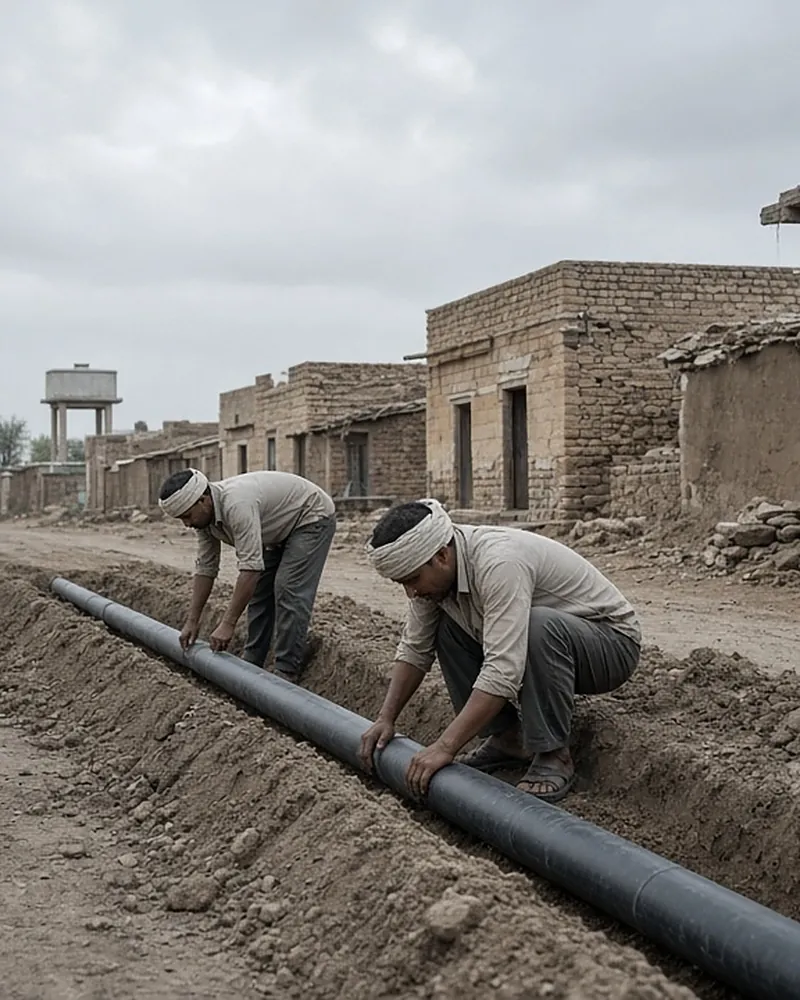
Jal Jeevan Mission (JJM) is India’s national programme to provide a working drinking-water tap to every rural household. Its tagline, Har Ghar Jal, means “water to every home”. The mission pays for village piped water schemes, the water sources that feed them, water quality testing, and the training and local institutions needed to keep those schemes running for years, not just months.
Here is the mission from the beginning: when it started, who runs it, what it is trying to achieve, what it pays for, how the work is organised from Delhi down to the village, and how the timeline has moved from the original 2024 target to December 2028.
Jal Jeevan Mission in brief
| Item | Detail |
|---|---|
| Announced | 15 August 2019 |
| Run by | Dept of Drinking Water & Sanitation, Ministry of Jal Shakti |
| Goal | A functional tap in every rural home |
| Service standard | 55 litres per person per day, BIS:10500 quality, regular supply |
| Deadline now | December 2028 (JJM 2.0) |
| Total outlay | ₹8.69 lakh crore, approved March 2026 |
Sources: About JJM; PIB, 10 March 2026.
Launch date and the ministry in charge
The Prime Minister announced Jal Jeevan Mission – Har Ghar Jal on 15 August 2019, in his Independence Day address. At that time only about 3.23 crore rural homes, roughly 17%, had a tap connection.
The mission sits in the Department of Drinking Water and Sanitation (DDWS), Ministry of Jal Shakti. A dedicated National Jal Jeevan Mission (NJJM), headed by a Mission Director, sets policy, releases central funds, approves State action plans and monitors progress.
Jal Jeevan Mission took over from, and absorbed, the earlier National Rural Drinking Water Programme (NRDWP). The older programme had mostly measured water in terms of habitations “covered” by handpumps or public standposts. The new mission changed the yardstick to a working tap inside each household’s premises.
Vision and mission
The official vision reads: every rural household has drinking water supply in adequate quantity of prescribed quality on a regular and long-term basis at affordable service delivery charges, leading to improvement in living standards of rural communities.
The mission is to assist, empower and facilitate:
- States and UTs to plan a participatory rural water supply strategy that ensures long-term drinking water security for every home and public institution, such as Gram Panchayat buildings, schools, anganwadi centres, health centres and wellness centres.
- States and UTs to build water supply infrastructure so every rural home has a functional tap connection with water of adequate quantity and prescribed quality on a regular basis.
- Gram Panchayats and rural communities to plan, implement, manage, own, operate and maintain their own in-village water supply systems.
- States and UTs to build strong institutions focused on service delivery and financial sustainability, using a utility approach.
- Capacity building of everyone involved, and public awareness of why safe water matters.
- Mobilising financial help for States and UTs to carry out the mission.
The eight objectives
| No. | Objective |
|---|---|
| 1 | A functional tap connection (FHTC) for every rural household |
| 2 | Priority to quality-affected, drought-prone and desert villages, and Sansad Adarsh Gram Yojana villages |
| 3 | Taps in schools, anganwadis, GP buildings, health and wellness centres and community buildings |
| 4 | Monitoring whether taps keep working |
| 5 | Community ownership through contribution in cash, kind or labour, including shramdaan |
| 6 | Sustainable water sources, infrastructure and funds for upkeep |
| 7 | Skilled local people for construction, plumbing, electrical work, water quality, treatment and maintenance |
| 8 | Awareness that safe water is “everyone’s business” |
Source: About JJM.
What the mission pays for
The official list of components shows that Jal Jeevan Mission is not only about pipes:
- In-village piped water supply to give every home a tap.
- Reliable water sources, or strengthening existing ones, so the scheme lasts.
- Bulk water transfer, treatment plants and distribution networks where a village has no good local source.
- Technology to remove contaminants where water quality is a problem, such as arsenic or fluoride.
- Retrofitting older schemes so they meet the 55 lpcd service level.
- Greywater management, so used household water from kitchens and bathing is handled safely and reused.
- Support activities such as awareness campaigns, training, utilities, water quality laboratories, testing and surveillance, and research.
States are expected to combine mission money with other sources wherever possible, such as Finance Commission grants to Panchayats and rural employment scheme works for water conservation. The related schemes page explains how these fit together.
How the work is organised
Water is a State subject in India. The Centre provides money, technical support and monitoring, while States plan, approve, build, operate and maintain schemes. The mission sets up a chain of institutions:
| Level | Body | Headed by |
|---|---|---|
| National | National Jal Jeevan Mission (NJJM) | Mission Director, DDWS |
| State | State Water and Sanitation Mission (SWSM) | Chief Secretary |
| District | District Water and Sanitation Mission (DWSM) | District Collector / DC |
| Village | Gram Panchayat or its VWSC / Pani Samiti | Sarpanch or as Gram Sabha decides |
Source: Institutional mechanism.
The District Water and Sanitation Mission meets monthly to give administrative approval to in-village schemes, plan protection of water sources and oversee greywater management. Under JJM 2.0 each district also gets a District Technical Unit to support Gram Panchayats with engineering advice and operation and maintenance.
At the village level, the Gram Sabha decides whether the Gram Panchayat itself or a sub-committee runs the water supply. That committee, the VWSC or Pani Samiti, is central to everything that happens in the village, from planning to monthly water charges. See Pani Samiti (VWSC).
How the money is shared
Jal Jeevan Mission is a centrally sponsored scheme, which means the Centre and the States share the cost. For building tap connections, the Centre pays the whole cost in UTs without a legislature, 90% in North Eastern and Himalayan States and UTs with a legislature, and 50% in other States. For support activities and water quality work, the split is 100:0, 90:10 and 60:40 respectively. Villages also contribute 5% or 10% of the cost of in-village works. The JJM 2.0 page has the full table.
Timeline from 2019 to 2028
| Date | What happened |
|---|---|
| 15 Aug 2019 | Mission announced; about 17% of rural homes had taps |
| 2019–20 | Approved for 2019–24 at ₹3.60 lakh crore (central share ₹2.08 lakh crore) |
| 16 Feb 2024 | Citizen Corner added to the JJM Dashboard |
| Mar 2024 | Coverage around 75%; more than 11.39 crore homes added |
| 1 Feb 2025 | Budget 2025–26 announces extension until 2028 |
| 10 Mar 2026 | Cabinet approves JJM 2.0 to Dec 2028; outlay ₹8.69 lakh crore |
| 2026 | Operational Guidelines for JJM 2.0 issued |
| 12 Nov 2026 | Dashboard shows 82.63% of rural homes with taps |
| Dec 2028 | Target: taps in all 19.36 crore rural homes |
Sources: PIB 2114280, PIB 2098368, PIB 2237548, JJM guidelines, JJM Dashboard.
The original target was a tap in every rural home by 2024. That deadline was missed in several large States. Reasons the States reported to Parliament include a lack of dependable sources in water-stressed, drought-prone and desert areas, natural contaminants in groundwater, difficult terrain, scattered habitations, delays in States releasing their matching share, limited technical capacity, rising material prices and delays in clearances. The extension to December 2028 is meant to finish the remaining homes and, just as important, make sure the taps already fitted keep working.
Why it matters: the gains officially cited
When it approved the extension in March 2026, the Government cited outside studies on the mission’s impact:
- SBI Research reported that the mission had freed about 9 crore women from fetching water.
- The World Health Organization estimated a saving of 5.5 crore hours a day of mainly women’s time, and the potential to prevent about 4 lakh deaths from diarrhoeal disease.
- Nobel laureate Prof. Michael Kremer estimated a potential 30% reduction in deaths of children under five, which would save about 1.36 lakh lives a year.
- IIM Bangalore and the International Labour Organization estimated 59.9 lakh direct and 2.2 crore indirect person-years of potential employment.
These are estimates of potential benefit, published by the Government in its Cabinet release. They depend on taps actually delivering safe water regularly, which is why functionality and water quality testing get so much attention.
Har Ghar Jal, Har Ghar Nal and other names
You will see several names for the same mission:
- Jal Jeevan Mission (JJM): the official name.
- Har Ghar Jal: the mission’s tagline, also used for a village’s status once every home has a tap (see Har Ghar Jal certification).
- Har Ghar Nal Se Jal: “water from a tap in every home”, used in some official documents.
- JJM 2.0: the restructured mission from March 2026 to December 2028.
- Har Ghar Nal Ka Jal and similar names are used by some States for their own linked schemes. State scheme rules can differ, so always check your State water department’s site.
Jal Jeevan Mission covers rural areas. Towns and cities are covered by a separate urban mission run by the Ministry of Housing and Urban Affairs. See related schemes.
FAQ
When was Jal Jeevan Mission launched?
It was announced on 15 August 2019. It was first approved to run from 2019–20 to 2023–24 and has since been extended to December 2028.
What does Jal Jeevan Mission aim to provide?
A functional household tap connection to every rural home, supplying at least 55 litres per person per day of water meeting BIS:10500 standards, regularly and over the long term.
Which ministry runs Jal Jeevan Mission?
The Department of Drinking Water and Sanitation in the Ministry of Jal Shakti, through the National Jal Jeevan Mission.
Is Jal Jeevan Mission for urban areas too?
No. Jal Jeevan Mission is for rural households. Urban water supply is handled under a separate mission of the Ministry of Housing and Urban Affairs.
What is the difference between JJM and NRDWP?
Jal Jeevan Mission absorbed the National Rural Drinking Water Programme. It measures success by working taps in each home rather than by habitations served through public sources.
Why was the 2024 deadline extended?
Many homes were still unconnected in 2024, and States reported problems such as scarce or contaminated sources, difficult terrain and funding delays. The extension to December 2028 is meant to finish coverage and make sure taps keep working.